PropInspect
Apartment Inspection: What to Check in the Unit and the Building
An apartment inspection is a walkthrough of a single unit that records its condition at move-in, move-out, or turnover, with photos and notes for each room. In an apartment, part of the job is drawing the line between what belongs to the unit and what belongs to the building.
Start a free inspection Create a free account
Unit or building? Draw the line first
In a house, everything on the lot is part of the rental. In an apartment, a stain on the ceiling may come from the unit upstairs, the heat may come from a central boiler, and the hallway carpet is the building's concern. Before you inspect, be clear about what the lease covers:
- Inside the unit: walls, floors, fixtures, cabinets, appliances, windows, and the water heater or heating and cooling equipment if the unit has its own
- Assigned to the unit: a parking space, a storage cage, a mailbox, a balcony or patio
- Shared and maintained by the building: hallways, laundry rooms, the roof, central heating and hot water, elevators, and the entry system
Record the condition of everything in the first two groups. For the third, note only what affects the unit, such as a radiator that barely warms up or an entry buzzer that doesn't ring through.
What to check inside the unit
Entry and security
If the building has self-closing fire doors, check that the unit door closes and latches on its own. Check the deadbolt, the peephole, and any chain or latch. Count every key and fob: the unit, the building entrance, the mailbox, storage, the garage, and amenities often have separate ones, and they can be expensive to replace.
Kitchen
Apartment kitchens are small and hard-working. Test every burner and the oven, the range hood fan and light, the fridge and freezer, the dishwasher, and the disposal. Look under the sink for leaks and for signs of pests, which travel between units through gaps around pipes.
Bathroom
Run the shower long enough to see whether the drain keeps up, check the caulk and grout, and test the exhaust fan by holding a square of toilet paper to it. A bathroom without a working fan grows mold quickly in a small apartment, and at move-out it's hard to say whose fault that was unless the fan's condition was recorded.
Ceilings, walls, and floors
Look up. Ceiling stains in an apartment often come from the unit above, and the move-in photo is what shows a stain was there before the tenant arrived. Check walls shared with neighbors for cracks, and wood or laminate floors for water damage near the kitchen and bathroom.
Windows, balcony, and outlets
Check window locks, screens, and any window guards. On a balcony or patio, photograph the railing, the floor surface, and the sliding door track. Test outlets with a plug-in tester; older buildings often have ungrounded outlets, which are worth noting so nobody blames the tenant later.
Safety
Press-test the smoke and carbon monoxide alarms in the unit and note where the nearest fire exit and extinguisher are. If an alarm is missing or dead, fix it before the tenant moves in, not after.
Photographing small rooms
Apartment rooms are small, which makes wide shots hard. A few tricks help:
- Stand in a doorway or corner and shoot towards the opposite corner, so two walls fit in each frame. Then turn and do the other two.
- Use the phone's ultra-wide (0.5x) lens if it has one; it fits a whole bathroom into one shot. Check that the edges aren't so distorted that a crack becomes hard to see.
- In a narrow galley kitchen, a short video walking the length of the room shows everything in one pass.
- Open every cabinet and closet and photograph the inside. In a small unit, storage is where damage hides.
- Photograph the view from each window. It sounds odd, but it identifies the room instantly in a report.
Interior bathrooms and hallways often have poor light. Switch on every light and use a flashlight rather than the camera flash, which bounces off tiles and mirrors and hides the very marks you're trying to show.
Problems that start outside the unit
Some problems in an apartment start somewhere else, and a good record helps sort out who is responsible:
- Water leaking from above: photograph the ceiling stain, note the date, and report it to the building manager in writing.
- Pests: roaches and bedbugs move between units. Note any evidence at move-in, so a later infestation isn't automatically blamed on the new tenant.
- Heat and hot water from a central system: note whether radiators get warm and how long the hot water takes to arrive.
- Noise and smells: they aren't condition items, but if a tenant raises them at move-in, write them down with the date.
When you report a building problem, ask for a written reply and keep it with the inspection record. If the same problem keeps coming back, that trail shows the building knew about it.
Timing in a busy building
In larger buildings, units turn over back to back, and there may be only a few days between one tenant leaving and the next arriving. Inspect the empty unit first, before painters and cleaners start. Then inspect again once the make-ready work is done, and use that second inspection as the new tenant's move-in record. Two short inspections are better than one rushed one trying to serve both purposes.
Use the same room names in every unit with the same floor plan. When a building has 20 identical one-bedrooms, consistent names make reports easy to compare and help you spot a pattern, such as the same bathroom fan failing in every unit on one riser.
Apartment make-ready checklist
Between tenants, use the move-out findings to build the make-ready list, then inspect again once it's done:
- Touch up paint in the same color and sheen, or repaint whole walls so patches don't show
- Recaulk the tub and kitchen sink if the caulk is stained or pulling away
- Replace the heating and cooling filter and test the thermostat
- Test every alarm and replace batteries, or the alarm itself if it's past its date
- Replace broken blinds, missing screens, and dead bulbs
- Rekey the lock or reprogram the entry code, and collect or deactivate old fobs
- Deep clean inside the oven, fridge, dishwasher, and cabinets
- Check under every sink for leaks, and treat for pests if there were any signs
- Confirm the mailbox, storage, and garage keys have all been returned
Keep a note of each unit's finishes, such as the paint color and sheen, the flooring, and the appliance models. It makes repairs match, and it helps when you're working out at move-out whether a carpet or an appliance was new or already old.
If you're the tenant
Do your own walkthrough on move-in day, even if the building gives you a form. Photograph each room, especially the ceilings, the floors, and the inside of the oven, fridge, and cabinets, and email the photos or a report link to the building's management the same day, so there's a dated copy on their side as well as yours. At move-out, do it again before you hand in the keys. Our tenant move-out checklist covers the rest.
State-specific deposit guidance
Deposit caps, return deadlines, and move-in checklist rules come from state law, and some cities add their own. Our security deposit laws by state guides summarize each state's rules with citations. New York, where many renters live in apartments, requires the landlord to offer the tenant a joint inspection before move-in.
Inspecting apartments with PropInspect
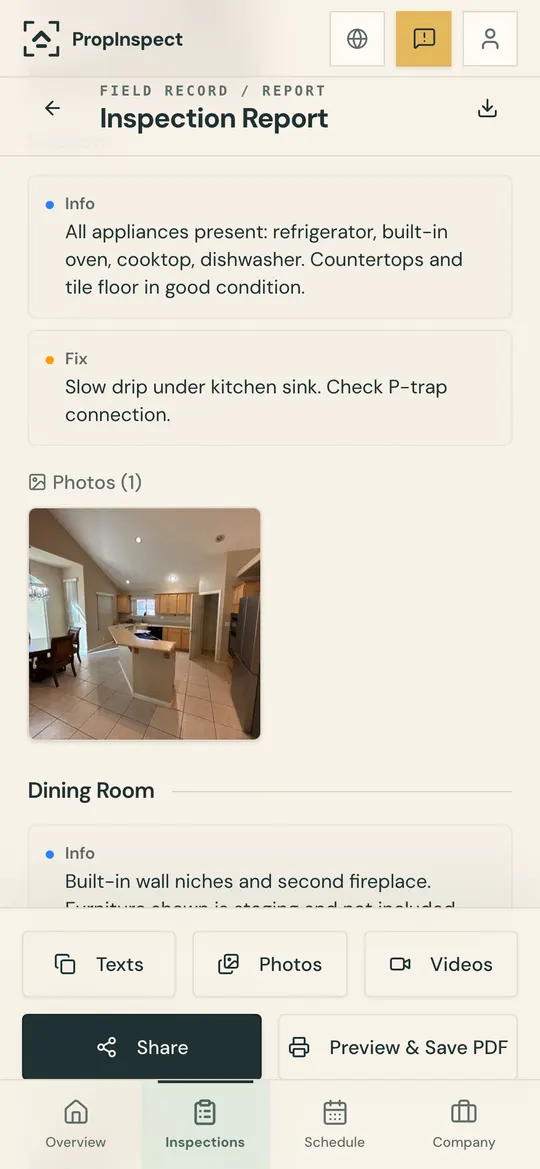
In PropInspect you type the unit's address and the rooms are set up for you. Set up each unit as its own property, so it keeps its own room layout and inspection history. In each room you take photos, record clips of up to 60 seconds for things like a galley kitchen or a slow drain, and tag notes Info, Fix, or Damage. In basements, garages, and concrete buildings where the signal drops, capture keeps working and you sync with one tap.
Each finished inspection is one report. Send the tenant or owner a read-only link that opens without an account, or a PDF.
Frequently asked questions
Can I use PropInspect for an entire apartment building?
Yes. Set up each unit as its own property, so it keeps its own room layout and inspection history, and share each report with the tenant or owner by link or PDF. Each inspection is $0.99, and the first one is free.
Do I need to download an app to inspect apartments?
No. PropInspect runs in your phone's browser — no app store download required. You can start your first apartment inspection with no account at all.
How much does it cost per unit?
Nothing per unit. You pay $0.99 per inspection, and your first one is free. A unit inspected at move-in and again at move-out costs $1.98 for the whole tenancy.
Who is responsible for a leak from the apartment upstairs?
Usually not the tenant below, but the answer depends on the lease and local law. What a condition record can do is show when the damage first appeared and that it was reported. Photograph it, note the date, and report it to the building in writing.
Walk the unit. The report's already done.
Photos, video and notes land in the right room as you go. Share one link before you're back at the office: the repair person sees what to fix, the tenant sees why, the owner sees everything.
- Done at the door, not at your desk
- One link for everyone. No account, no app.
- Dated, room-by-room proof for when the deposit is due
First inspection free, then $0.99. No subscription.