PropInspect
Move-Out Inspection: How to Document Deductions Fairly
A move-out inspection is the landlord's walkthrough of a rental after the tenant leaves, compared against the move-in record to decide what, if anything, comes out of the security deposit. Every deduction should trace back to a difference between the two records.
Start a free inspection Create a free account
Timing: after the keys, before the cleaners
Inspect once the tenant has returned the keys and removed their belongings, and before any cleaner, painter, or contractor starts. Once work begins you can only show the condition after your own crew, not the condition the tenant left.
Start early, because the deposit clock is already running. Return deadlines vary widely by state, often somewhere between 14 and 60 days after the tenant leaves, and a few states set no single fixed deadline. New York, for example, allows 14 days, while Maryland and Virginia allow 45. The inspection, the repair estimates, and the written statement all have to fit inside whatever window applies to your rental.
Some states also give tenants an inspection before they leave. In California, a tenant can ask for an initial inspection about two weeks before moving out, so they can fix what you point out. Where nothing requires it, it's still worth offering: problems the tenant fixes are problems you don't have to price and defend.
If the tenant wants to attend the final inspection, let them. In some states, including Virginia and Maryland, tenants have a right to be there if they ask in time.
Compare against the move-in record, room by room
Open the move-in report before you start and walk the same route in the same order. In each room, look at the move-in photo of each wall and floor, then take the matching shot from the same spot. Matching pairs make a deduction self-explanatory: the reader sees before and after side by side and doesn't need your opinion.
Sort what you find into three kinds: unchanged (the photo is enough), changed but within normal wear (note it, no deduction), and damaged or missing (note it, measure it, photograph it close up, and flag it). Treat cleaning separately. A dirty oven isn't damage, but many states let a landlord deduct reasonable cleaning costs to bring the unit back to its move-in level of cleanliness.
Count everything that was handed over: keys, fobs, garage remotes, parking permits, window screens, and any furnishings listed in the lease.
Normal wear and tear versus damage
Nearly every state bars deductions for normal wear and tear, and nearly every deposit dispute is an argument about where it ends. A useful test: wear comes from time and ordinary living, while damage comes from an accident, neglect, or misuse. Some typical pairs:
- Carpet worn thin along walkways is wear; burns, pet urine stains, or rips are damage.
- Paint that has faded or picked up light scuffs is wear; crayon, large gouges, or an unapproved color is damage.
- A few small nail holes from pictures are usually wear; dozens of wall anchors or the holes from a TV mount are damage.
- A loose door handle after years of use is wear; a kicked-in door or a key snapped off in the lock is damage.
- Light discoloration in grout is wear; mold from never running the bathroom fan can be damage, depending on the cause.
- Sun-faded blinds are wear; bent or snapped slats are damage.
The age of the item matters too. A carpet that was already eight years old at move-in has little value left, so even real damage may justify only a small deduction. That's why a good move-in record notes the age and condition of the major finishes.
Putting a fair number on each deduction
Charge what it actually costs to fix the damage, not what it costs to upgrade. Keep an invoice, a receipt, or a written estimate for each item, filed with its photo. If you do the work yourself, record your hours and materials; some states require the itemized statement to show how each amount was worked out.
Take the item's remaining useful life into account. Paint, carpet, and appliances wear out over a known span of years, and courts often ask how much life was left. Charging a tenant for a new carpet to replace one that was due for replacement anyway is one of the most common ways a deduction gets cut down in small claims court.
Don't charge for the same thing twice. If you deduct for repainting a wall, the patching of holes in that wall belongs in the same line, not a separate one.
Writing the itemized statement
Most states require a written, itemized list of deductions sent with any remaining deposit by a deadline. Write each line so it stands on its own: the room, what was damaged, what you did about it, and the amount. "Living room: two 3-inch holes behind the door from a missing door stop; patched and repainted the wall; $140, invoice attached" is hard to argue with. "Wall repair: $300" invites a dispute.
Include the evidence or a link to it. A move-out report with matching move-in photos lets the tenant check every line themselves, which settles most disagreements before they become formal. Send it in a way that leaves a dated record, such as email, and keep a copy.
If the tenant didn't leave a forwarding address, send the statement to the last address you have and by email as well, and keep proof of when you sent it. A statement sent on time to the wrong place is still better than one sent late.
Belongings left behind
If the tenant leaves furniture or other belongings, photograph them where they are before you move anything. Check your state's rules on abandoned property before you throw anything away; many states require written notice and a waiting period first. The cost of removal and disposal can often be deducted, but only if it is documented and reasonable.
When the tenant disagrees
Most disputes are settled by evidence, not argument. If a tenant challenges a deduction, send the before and after photos for that item and the invoice again. If you can't produce a move-in photo that shows the item in better condition, think hard about whether the deduction would survive a judge; in many states the landlord carries the burden of showing the deposit was withheld properly.
Withholding in bad faith is expensive. Several states let a court award two or three times the amount wrongly withheld, plus attorney's fees, and Texas presumes bad faith when the refund or the itemized list is more than 30 days late. Being late or vague can cost more than the deduction was worth.
Move-out inspection checklist
- Keys, fobs, remotes, and permits returned and counted
- Every wall and ceiling: holes, anchors, stains, and paint that doesn't match
- Floors: burns, pet stains, deep scratches, and water damage near the dishwasher and toilets
- Kitchen: inside the oven, fridge, freezer, and dishwasher; cabinet doors and hinges; leaks under the sink
- Bathrooms: cracked fixtures, failed caulk, mold, and whether the exhaust fan works
- Windows, screens, and blinds present and intact
- Smoke and carbon monoxide alarms present and working
- Belongings or trash left behind, inside and outside
- Final meter readings, photographed
- A matching move-in photo for every item you plan to deduct
State-specific deposit guidance
Return deadlines, deduction rules, and the penalties for getting them wrong vary a lot from state to state. Our security deposit laws by state guides set out each state's deadline and itemization rules with citations to the statute. Read the one for your rental before you send the statement.
Running the move-out inspection with PropInspect
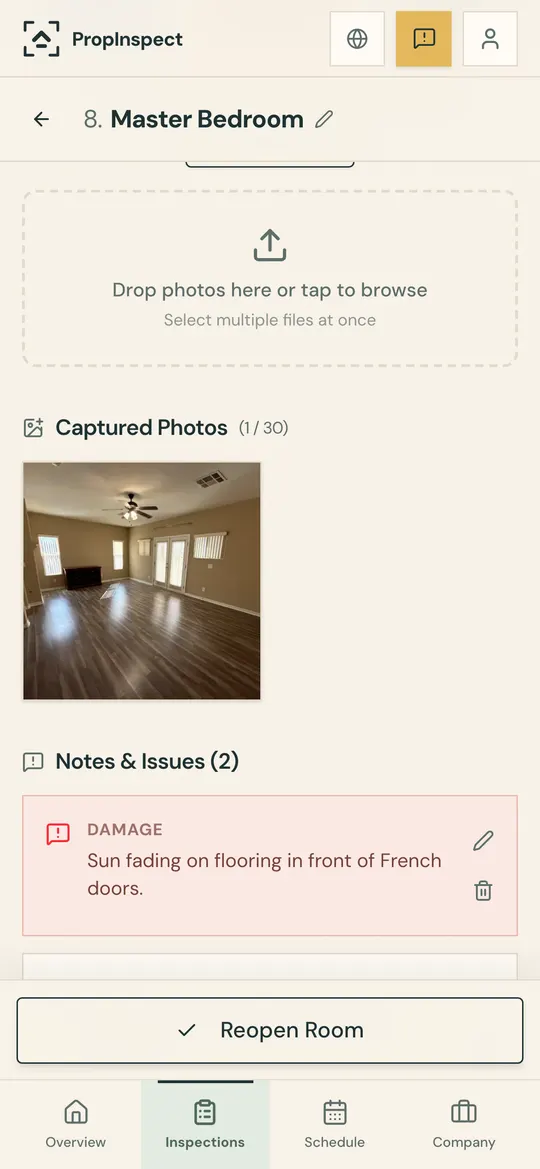
Use the same property in PropInspect at move-out that you used at move-in, so the rooms come up with the same names in the same order. Photograph each room, record a clip of up to 60 seconds where a still photo won't show the problem, and tag each note Info, Fix, or Damage, so the deductions are easy to pick out of the report.
PropInspect doesn't build a side-by-side comparison for you yet, so keep the move-in report open in another tab and match the shots yourself. When you're done, send the tenant the read-only link or a PDF with your itemized statement. The link opens without an account.
Frequently asked questions
What is the difference between wear and tear and damage?
Normal wear and tear is the expected, gradual decline from ordinary use — faded paint, light carpet wear, small nail holes. Damage is beyond ordinary use — large holes, stains, broken fixtures, or neglect. You can generally deduct for damage but not for normal wear. Photo documentation makes the distinction clear.
How soon should I do a move-out inspection?
Do it as soon as the tenant vacates and the unit is empty, ideally before any cleaning or repairs begin, so the report reflects exactly how the property was left. Many states also have deadlines for returning deposits, so prompt documentation matters.
Can I deduct for cleaning?
Often, if the unit is dirtier than it was at move-in, beyond ordinary use. The usual benchmark is the level of cleanliness when the tenant moved in, which is another reason your move-in photos should show clean appliances and floors. The rules differ by state, so check the guide for yours.
Can I share the move-out report with my tenant?
Yes. PropInspect generates a read-only shareable link (and PDF) you can send with the security deposit statement, showing photos, videos, and notes for every documented issue.
Walk the unit. The report's already done.
Photos, video and notes land in the right room as you go. Share one link before you're back at the office: the repair person sees what to fix, the tenant sees why, the owner sees everything.
- Done at the door, not at your desk
- One link for everyone. No account, no app.
- Dated, room-by-room proof for when the deposit is due
First inspection free, then $0.99. No subscription.