PropInspect
Section 8 Inspection Checklist
A Section 8 inspection is the check a public housing agency (PHA) makes before a Housing Choice Voucher tenancy starts, and periodically afterwards, to confirm the unit meets HUD's Housing Quality Standards (HQS). Assistance payments generally depend on the unit passing, so most landlords walk the unit against the same checklist first.
Start a free inspection Create a free account
Important: this is not the official inspection
PropInspect is a documentation tool, not an inspection service, and is not affiliated with HUD or any public housing agency. The official inspection is performed by your PHA's inspector. Documenting your unit with PropInspect does not guarantee a passing result — use it to find and fix likely fail items before the inspector arrives.
Content last reviewed against HUD sources: September 2026
The 13 HQS performance areas inspectors check
HUD's Housing Quality Standards are organized into thirteen performance areas, recorded on HUD Form 52580. Through January 31, 2027, voucher inspections use HQS as defined before the NSPIRE rule. Here's what each area covers and what a typical failure looks like.
1. Sanitary facilities
A private flush toilet, fixed basin, and tub or shower with hot and cold water, all in working order. Clogs, severe leaks, and sewer-gas smells fail.
2. Food preparation and refuse disposal
A working stove or range, refrigerator, kitchen sink with hot and cold water, space to prepare food, and refuse disposal. Dead burners and missing appliances fail.
3. Space and security
Adequate space for the family, and exterior doors and accessible windows that lock. Missing deadbolts and broken window locks are common fails.
4. Thermal environment
A heating system that can keep the unit healthfully warm for the climate, safely installed and vented. Inoperable furnaces and unvented fuel space heaters fail.
5. Illumination and electricity
Adequate light in every room and a safe electrical system. Exposed wiring, missing outlet or switch cover plates, and dead fixtures are among the most frequent fails on HUD Form 52580.
6. Structure and materials
Sound ceilings, walls, and floors, a weather-tight roof, and stable stairs and porches. Large holes, sagging ceilings, rotted flooring, and broken steps fail.
7. Interior air quality
Free of air pollutants that threaten health, with ventilation in bathrooms and kitchens. Sewer-gas odor and bathrooms with no window or vent fail.
8. Water supply
Safe, uncontaminated hot and cold running water on an approved system. A water heater missing its temperature-pressure-relief valve or discharge pipe is a classic fail.
9. Lead-based paint
In units built before 1978, all painted surfaces must be intact — no peeling, chipping, chalking, or cracking paint, inside or out, with extra scrutiny when children under six live there.
10. Access
Direct access without passing through another unit, and a usable exit in a fire or other emergency. Blocked exits and barred windows on the only escape route fail.
11. Site and neighborhood
The site must be free of hazards affecting the unit: dangerous drainage, accumulated refuse, fire hazards, and dilapidated structures. Trash piles and abandoned appliances are typical findings.
12. Sanitary condition
Free of vermin and rodent infestation. Visible roaches or rodent droppings fail an otherwise sound unit, so document treatment before inspection day.
13. Smoke detectors
Working smoke alarms per the standard HUD strengthened in December 2024: on every level, inside each bedroom, and outside sleeping areas, hardwired or sealed 10-year battery. Missing or dead alarms are the most common Section 8 fail.
The most common Section 8 inspection failures (and the fixes)
These ten items account for most failed HQS inspections. All of them are cheaper to fix before inspection day than after — a fail means a repair window, a re-inspection, and delayed payments.
Smoke and carbon monoxide alarms
Why it fails: Missing, dead, or wrongly placed alarms — HUD's December 2024 standard expects alarms on every level, in bedrooms, and outside sleeping areas.
The fix: Install or replace alarms to the current standard and test each one. Typical cost: About $10–$40 per battery or sealed-unit alarm.
GFCI protection near water
Why it fails: Many PHAs and local codes expect GFCI outlets in kitchens and baths, and GFCI/AFCI protection is an explicit NSPIRE requirement once NSPIRE governs voucher inspections.
The fix: Have an electrician install GFCI receptacles or breakers where required. Typical cost: Roughly $125–$250 per outlet installed.
Missing outlet, switch, and junction box covers
Why it fails: Exposed wiring and uncovered boxes are electrical hazards on the HUD inspection form.
The fix: Replace every missing cover plate and cap unused junction boxes. Typical cost: A few dollars per plate — the cheapest fail on this list.
Peeling or chipping paint in pre-1978 units
Why it fails: Deteriorated paint in pre-1978 housing is treated as a lead hazard, especially with children under six in the unit.
The fix: Stabilize surfaces with lead-safe practices — an EPA RRP-certified renovator beyond minor touch-up. Typical cost: From about $200 for small areas to $1,500+ per room.
Water heater relief valve and discharge pipe
Why it fails: A missing or improperly routed temperature-pressure-relief discharge pipe is a scalding and burst hazard.
The fix: Have a plumber replace the valve and route the discharge pipe correctly. Typical cost: About $150–$350 with a plumber.
Inoperable stove burners or oven
Why it fails: Food preparation is a required HQS area — all burners, the oven, and the refrigerator must work.
The fix: Replace the element or igniter, or repair or replace the appliance. Typical cost: About $20–$150 for parts; several hundred for an appliance.
Missing handrails on stairs
Why it fails: Stairs need a secure rail under HQS structure and access checks; guardrails are also an explicit NSPIRE requirement.
The fix: Install or re-secure a graspable handrail along the full run. Typical cost: About $100–$400 installed.
Broken window panes and missing locks
Why it fails: Windows must be intact, operable, and lockable for security.
The fix: Reglaze or replace the pane and install sash locks. Typical cost: About $50–$200 per window; locks are a few dollars each.
Plumbing leaks and slow drains
Why it fails: Leaks, running toilets, and slow drains fail the sanitary facilities and water supply areas.
The fix: Replace washers and traps, reseat toilets, and auger slow lines. Typical cost: About $10 DIY to $300 with a plumber.
Evidence of infestation
Why it fails: Roach or rodent evidence fails the sanitary condition requirement even in an otherwise sound unit.
The fix: Schedule licensed pest treatment, seal entry points, and keep the receipt as proof. Typical cost: About $100–$400 for an initial treatment.
Cost figures are ballpark planning ranges, not quotes — actual costs vary by market, unit, and contractor.
The Section 8 inspection process, start to finish
Every public housing agency (PHA) runs its own calendar and some set their own procedures — the federal rules set the guardrails below, but confirm timelines and requirements with your PHA.
1. The PHA schedules the inspection
Your local public housing agency (PHA) inspects before a voucher tenancy begins and then periodically — every one or two years for most programs. Scheduling varies by PHA.
2. The inspector walks the unit
Working from HUD Form 52580, the inspector tests detectors, plumbing, appliances, outlets, windows, and exits room by room — usually 20 to 60 minutes. Utilities must be on, or untestable systems are marked inconclusive.
3. Pass, fail, or inconclusive
The inspector records a summary decision. A fail lists each deficiency; inconclusive usually means something couldn't be tested and needs a follow-up.
4. The repair window
Under 24 CFR 982.404, life-threatening deficiencies must be fixed within 24 hours of notification; other deficiencies generally within 30 days or a PHA-approved extension. Tenant-caused deficiencies are the family's responsibility.
5. Re-inspection or verification
The PHA verifies repairs — many accept dated photos or other reliable evidence instead of a return visit, which is exactly what a PropInspect report provides. A PHA may charge the owner a re-inspection fee for unmade repairs; it cannot be passed to the family.
6. Payments begin or resume
Once the unit passes, housing assistance payments (HAP) begin or resume. Some PHAs start payments when only non-life-threatening items remain. If an owner never repairs, the PHA must abate payments and can terminate the contract. Timelines and options vary by PHA.
NSPIRE is coming: what changes and when
Housing Quality Standards (HQS) remain the operative standard for Housing Choice Voucher, Project-Based Voucher, and Section 8 Moderate Rehabilitation inspections today. HUD has extended the NSPIRE compliance date for voucher programs three times — most recently in a September 30, 2025 Federal Register notice — and NSPIRE governs voucher inspections beginning February 1, 2027. HQS applies through January 31, 2027, and some PHAs may adopt NSPIRE earlier, so follow your PHA's notices, not just the federal date.
NSPIRE is already used for HUD's public housing and multifamily portfolios; the 2027 date covers the voucher programs. Current transition procedures are in PIH Notice 2026-18 (July 2026).
What changes under NSPIRE
- Inspectable areas reorganize into Unit, Inside, and Outside, replacing the room-by-room HQS form.
- Defects are graded Life-Threatening, Severe, Moderate, or Low, with defined correction windows instead of a single pass/fail.
- More weight goes to conditions inside the unit where residents actually live.
- Affirmative requirements become explicit: smoke and CO alarms, GFCI/AFCI protection where required, fire-labeled doors, guardrails, and HVAC standards.
How to prepare now
- Walk the unit now against both the HQS list and HUD's NSPIRE HCV/PBV checklist.
- Fix life-safety items first — alarms, egress, electrical hazards — they carry the shortest correction windows under both standards.
- Keep dated photo documentation of condition and repairs so re-verification is fast under either standard.
HUD publishes every NSPIRE notice, including any future date changes, on its NSPIRE notices page.
What tenants should know about a Section 8 inspection
If a unit fails, the landlord gets a repair window — 24 hours for life-threatening problems, generally 30 days for the rest. The PHA can withhold or abate its assistance payments to the landlord until the unit passes, so the immediate financial pressure lands on the owner. But if the unit never passes, the PHA can end the payment contract and you may need to move with your voucher — so report unresolved problems promptly.
Not every deficiency is the landlord's job — housekeeping and household-caused damage can be cited as the family's responsibility. Keep the unit reasonably clean and report maintenance problems in writing before inspection day.
- A PHA may not charge the family for an initial inspection or a re-inspection.
- If the landlord will not make required repairs, report it to your PHA — it can abate payments, terminate the contract, and often help you move with your voucher.
- Photograph problems as you find them; dated photos make disputes about who caused damage much easier to resolve.
A two-week prep plan before the inspection
- When the tenant's request for tenancy approval goes in, ask your PHA how it schedules inspections and whether it accepts photo verification of repairs.
- Two weeks out: walk the unit against the readiness checklist below and photograph every room, so you have a dated starting point.
- Book the slow fixes first: an electrician for GFCI outlets, a plumber for the water heater relief valve, and any pest treatment that needs a follow-up visit.
- One week out: do the cheap fixes yourself, such as cover plates, alarms, window locks, burner elements, and caulk.
- Two days out: confirm gas, water, and power are on, pilot lights are lit, and the inspector can reach the water heater, the breaker panel, and every room.
- The day before: walk the unit again and photograph each fix in the spot where the problem was.
- Inspection day: be there, or have someone there who can open every door and answer questions.
Section 8 / HQS readiness checklist
Common items an HQS inspector will check — the details behind each one are in the 13 performance areas above:
- Working smoke alarms on every level, in bedrooms, and outside sleeping areas
- Carbon monoxide alarms where fuel-burning appliances or attached garages are present
- No peeling, chipping, or cracking paint in pre-1978 units (lead-paint hazard)
- All windows operable and lockable, no broken glass
- Two working exits that are clear and unobstructed
- Hot and cold running water with no leaks
- Working, safely vented heating in every room
- No exposed wiring, broken switches, or missing outlet and junction box covers
- Functioning toilet, sink, tub or shower
- Stove and refrigerator present and working
- Secure handrails on stairs and steps
- No visible signs of pests, mold, or moisture
- Sound floors, walls, ceilings, and stairs
- Water, power, and gas turned on so every system can be tested
The full interactive property inspection checklist covers general condition items beyond HQS.
Documenting repairs so the PHA can verify them
Under 24 CFR 982.405, a PHA may verify that deficiencies were corrected using photos or other reliable evidence instead of a return visit, though not every PHA does. Where yours does, the quality of your photos decides how quickly payments start or resume.
- Photograph each deficiency before you fix it, with the item number from the inspection notice written on a sticky note in the frame if you can.
- After the repair, take the same shot from the same spot, plus a wider shot that shows where in the unit it is.
- For alarms, show the alarm installed and, if possible, its test light on; for GFCI outlets, show the test button and the outlet's location.
- Keep receipts and invoices for parts and contractor work, especially lead-safe paint work and pest treatment.
- Send the evidence the way your PHA asks for it, by the deadline on the notice, and keep a copy of what you sent and when.
Annual and biennial inspections with a tenant in place
After the initial inspection, the PHA inspects again periodically, and it can also inspect after a complaint. These visits happen with the family living in the unit, so the deficiencies tend to be different: dead alarm batteries, clogged drains, broken blinds, and housekeeping issues rather than missing appliances.
Do your own walkthrough a few weeks before the PHA's date, giving the notice your lease and state law require. Fix the owner's items, and give the tenant a written list of anything that is the family's responsibility under 24 CFR 982.404, so they have time to deal with it. Keep photos of what you found and what you fixed; if a tenant-caused item fails, your dated record shows when it appeared.
Voucher tenancies still need move-in and move-out records
An HQS inspection isn't a condition record for the security deposit. It records pass or fail against federal standards, not the state of the carpet or the number of nail holes in a bedroom wall. For the deposit you need your own move-in record and, later, a move-out record, just as with any other tenancy. Our move-in inspection guide covers how.
The deposit itself is governed by state and local law. Under 24 CFR 982.313, a PHA may also bar you from charging a voucher tenant more than you charge unassisted tenants or more than is customary in the local market.
Official HUD sources
This page is a plain-English summary. Verify anything you act on against the primary sources:
- 24 CFR 982.401 — Housing Quality Standards (HQS)
The voucher HQS regulation. Through January 31, 2027, PHAs apply HQS as it was defined before the NSPIRE rule — the 13 areas above come from that definition and HUD Form 52580.
- 24 CFR 982.401 — pre-NSPIRE text, as of September 28, 2026
A dated snapshot of the HQS definition as last verified, so the pre-NSPIRE text remains traceable once the eCFR 'current' view switches to the NSPIRE-based definition on February 1, 2027.
- 24 CFR 982.404 — Owner and family maintenance responsibilities
Repair deadlines, tenant-caused deficiencies, and PHA enforcement.
- 24 CFR 982.405 — PHA inspection procedures
Inspection schedules, re-inspection fees, and photo verification of repairs.
- HUD Form 52580 / 52580-A — Inspection Checklist and Inspection Form
The actual checklist HQS inspectors work from.
- HUD — NSPIRE official notices and proposed rules
Every NSPIRE notice, including the voucher-program compliance extensions.
- PIH Notice 2026-18 — NSPIRE procedures for voucher programs
The current administrative procedures for the HCV/PBV transition to NSPIRE.
State rules that still apply
HQS is a federal standard, but everything around the tenancy still varies by state — security deposit rules, habitability requirements, and notice periods among them. If you're preparing a voucher unit, these state guides cover the deposit side of the ledger:
Documenting a pre-inspection walkthrough
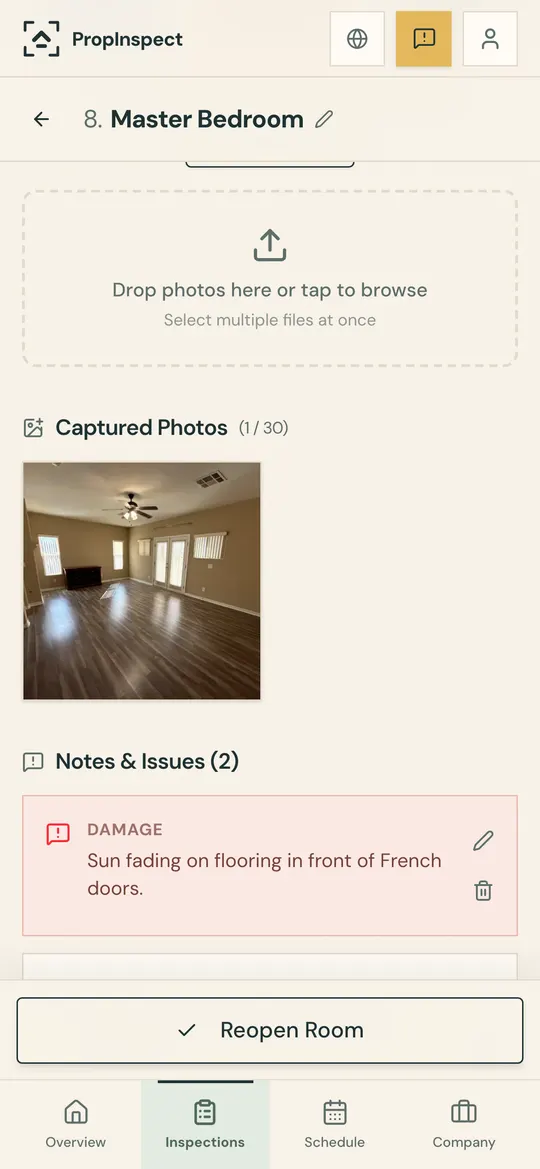
PropInspect makes your own pre-inspection walkthrough quicker to document. Type the address and the rooms are set up for you, then photograph each room, record clips of up to 60 seconds, and tag notes Info, Fix, or Damage, using Fix for every item you need to correct before the inspector arrives.
The finished report is dated and organized room by room, so before-and-after repair photos are easy to find when your PHA accepts photo verification. Share it as a read-only link that opens without an account, or as a PDF.
Frequently asked questions
What is a Section 8 / HQS inspection?
It's the inspection required for Housing Choice Voucher (Section 8) units. A housing authority inspector checks the unit against HUD's Housing Quality Standards — 13 performance areas covering sanitation, safety, structure, and utilities. In most cases assisted payments begin once the unit passes, though a housing agency can start them when the only deficiencies are non-life-threatening.
Can PropInspect perform the official Section 8 inspection?
No — the official inspection is conducted by your local housing authority's inspector, and PropInspect is not affiliated with HUD or any housing agency. PropInspect is a pre-inspection tool that helps you document the unit and fix likely fail items before the inspector arrives.
How long does a Section 8 inspection take?
Usually 20 to 60 minutes depending on unit size and condition. Make sure utilities are on — anything the inspector can't test is typically marked inconclusive rather than passed.
What happens if my unit fails the inspection?
You get a repair window: 24 hours for life-threatening items, generally 30 days for the rest under 24 CFR 982.404. The PHA then re-inspects or verifies the repairs, and payments begin or resume once the unit passes. Some PHAs start payments when only non-life-threatening items remain.
How soon is the re-inspection after repairs?
It varies by PHA — from days to a few weeks. Ask whether yours accepts photographic verification instead of a return visit; 24 CFR 982.405 allows PHAs to verify corrections with photo or other reliable evidence, which is often much faster.
What is NSPIRE and when does it replace HQS?
NSPIRE (National Standards for the Physical Inspection of Real Estate) is HUD's replacement inspection model. For voucher programs it takes effect February 1, 2027 — HQS applies through January 31, 2027, and some PHAs may adopt earlier. NSPIRE sorts conditions into Unit, Inside, and Outside areas with defects graded Life-Threatening, Severe, Moderate, or Low.
Do smoke detectors need to be hardwired for Section 8?
Under the standard HUD adopted in December 2024, smoke alarms must be hardwired or have sealed 10-year batteries, installed on every level, inside each bedroom, and outside sleeping areas. Carbon monoxide alarms are required with fuel-burning appliances or attached garages. Confirm local code additions with your PHA.
What are the most common reasons units fail?
Missing or dead smoke alarms top the list, followed by peeling paint in pre-1978 units, electrical hazards like missing cover plates, inoperable windows or missing locks, plumbing leaks, blocked exits, and pest evidence. Nearly all are cheap to fix before inspection day.
Walk the unit. The report's already done.
Photos, video and notes land in the right room as you go. Share one link before you're back at the office: the repair person sees what to fix, the tenant sees why, the owner sees everything.
- Done at the door, not at your desk
- One link for everyone. No account, no app.
- Dated, room-by-room proof for when the deposit is due
First inspection free, then $0.99. No subscription.
PropInspect is a documentation tool, not an inspection service, and is not affiliated with HUD or any public housing agency. The official inspection is performed by your PHA's inspector. Documenting your unit with PropInspect does not guarantee a passing result — use it to find and fix likely fail items before the inspector arrives.