PropInspect
Property Management Inspection Software: A Practical Buyer's Guide
Property management inspection software is the tool a management company uses to run move-in, routine, and move-out inspections consistently across many properties and inspectors, and to deliver the results to owners and tenants. The software matters less than the standard it enforces: the same rooms, the same photos, and the same kind of notes on every report.
Start a free inspection Create a free account
What the software has to do
For a management company, an inspection report has two readers. The owner wants proof the asset is being looked after and early warning of capital repairs. The tenant needs a fair record for the deposit. The software has to produce one report that serves both, from inspectors with different habits and levels of experience.
- Structured capture: rooms, photos, video, and notes recorded in a fixed order
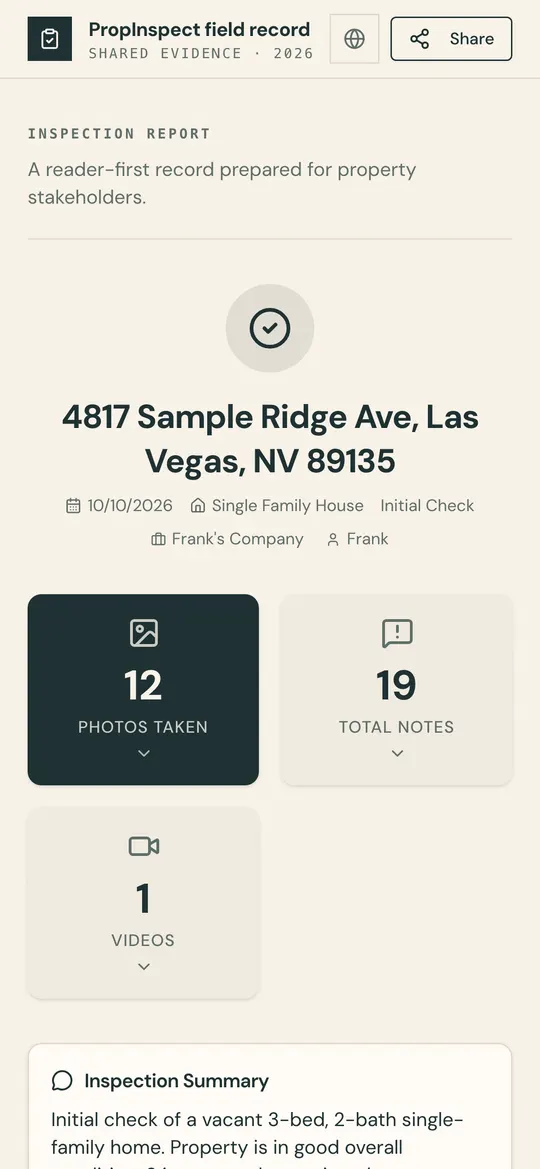
- Consistent reports carrying your company's brand, which owners and tenants can open without logging in
- A history per property, so this year's routine inspection can be read against last year's
- Storage for the documents that belong with the property: leases, insurance, and permits
- Pricing that makes sense at your volume
Write your inspection standard before you choose a tool
Teams produce inconsistent reports because inspectors make different choices, not because their software differs. Write a one-page standard and train everyone to it:
- Room naming: for example, Bedroom 1 is always the one nearest the entry, and a half bath is always called one.
- A shot list per room: one wide shot of each wall, then close-ups of every finding with something for scale.
- Note format: location, item, condition, and size, as in "Hall bath, vanity door: hinge pulled out of the frame."
- Condition words: a short fixed list such as new, good, worn, damaged, and missing, with a definition for each.
- What to test: every burner, tap, toilet, alarm, and outlet, every time.
- Turnaround: the report is finished on site and sent to the tenant and owner within 24 hours.
A standard like this makes reports comparable whoever did the inspection, and it makes move-outs much faster, because the move-in photos already show the same angles.
Reporting to owners
Owners rarely read a 150-photo report from start to finish. Send a short summary with it: overall condition, anything that needs a decision (a water heater near the end of its life, a roof leak), and anything that affects the deposit. Then link the full report for anyone who wants the detail.
Keep the condition record separate from your recommendations. Photos and notes should be neutral. Advice about replacing the carpet before the next lease belongs in your cover note, so the report itself stays usable as deposit evidence.
Agree with each owner at the start how often units are inspected and what triggers an extra visit, such as a complaint, a leak, or a lease renewal. Put it in the management agreement so a routine inspection is never a surprise cost.
Training inspectors
Keep one finished report as the reference: a real unit, inspected the way you want every unit inspected, with the photos and notes your standard calls for. New inspectors study it, shadow an experienced colleague on two or three inspections, and then do one while the experienced colleague watches.
Review the first five reports from every new inspector before they go to owners or tenants. The same mistakes come up again and again: no wide shots, so close-ups can't be placed; notes without a location; appliances that weren't switched on; and rooms named differently from the move-in report. Each one is easy to fix once it's pointed out, and much harder to fix at move-out.
Handling deposit disputes as a manager
Your management agreement should say who decides deductions, you or the owner, and who approves the statement. Settle that before the first move-out, not during it. Whoever decides, the statement should go out under your company's name, on time, with the evidence attached.
When a tenant challenges a charge, answer in writing, attach the matching move-in and move-out photos, and keep the whole exchange on file. If the owner wants a deduction your evidence won't support, say so in writing. Defending a weak charge in small claims court costs more than the charge, and the deadline penalties in some states fall on whoever sent the statement late.
Per-unit, per-month, or per-inspection pricing
Most inspection platforms charge per unit per month, or by tiers of units. That suits a company that inspects every unit several times a year and connects inspections to accounting and maintenance software. It's expensive for a manager with a small or seasonal portfolio, who pays the same in a quiet month as in a busy one.
Work out your real inspection count before comparing prices. A portfolio of 40 units with tenancies that average two years and one routine visit a year comes to roughly 20 move-ins, 20 move-outs, and 40 routine inspections: about 80 inspections a year. Price each option against that number, not against the headline rate.
Ask every vendor the same questions. Can owners and tenants open reports without an account? Can you export every report as a PDF if you leave? What happens to your data when you stop paying? Does capture work without signal? Are vacant units still billed?
Keeping reports after the tenancy
Keep inspection reports for at least as long as a deposit claim or lawsuit could still be brought, which varies by state; many managers keep them for several years. Store them under the property, not on an inspector's phone or in a personal inbox, so they survive staff changes. Our rental record retention guide has more detail.
When a full platform is the better choice
If you run weekly inspections across hundreds of doors, need work orders that flow into maintenance software, or want custom templates for each owner, a full property management platform with an inspection module is the right purchase. At that volume its per-unit price beats paying per inspection, and the integrations save real staff time.
A lighter per-inspection tool suits small management companies, managers who look after a few properties alongside other work, and companies that mainly need clean move-in and move-out records rather than a full maintenance system.
Rolling out a new inspection process
- Pilot it on one property type with one inspector, and fix the standard before you train everyone.
- Have two inspectors each inspect the same unit and compare their reports. The differences show where the standard is vague.
- Keep the old reports for current tenancies where you can reach them. You'll need them at move-out.
- Tell owners what's changing and send them a sample report first.
Expect the first month to be slower. Reports get faster once inspectors know the shot list by heart, and the time saved at move-out, when the move-in photos already match, is where the standard pays for itself.
Track two numbers for the first three months: how long a typical inspection takes, and how many move-out deductions tenants challenge. If the standard is working, the first stays flat and the second goes down.
State-specific deposit guidance
Managing across state lines means following several sets of deposit rules at once: different caps, return deadlines that vary widely (often 14 to 60 days, and a few states set no single fixed deadline), and in some states required move-in paperwork. Our security deposit laws by state guides summarize each state's rules with citations. Washington and Massachusetts are two states where the move-in paperwork is itself a legal requirement.
Where PropInspect fits for a management company
PropInspect is the lighter option. It's priced per inspection, $0.99 each with no subscription, so a quiet month costs nothing. Every property keeps its own room layout and inspection history, and your company logo appears on the reports. Owners and tenants open a read-only link without an account, or you send a PDF.
Inspectors capture photos, clips of up to 60 seconds, and notes tagged Info, Fix, or Damage, room by room, and capture keeps working if the signal drops. Each property also keeps its documents, with anything expiring flagged in the app 30 days ahead. PropInspect doesn't connect to accounting or maintenance systems; if you need that, a full platform is the better fit.
Frequently asked questions
Can I add my company branding to reports?
Yes. Upload your company logo and it appears on your inspection reports and shareable links, giving owners a polished, branded experience.
Is there a per-seat subscription?
No. PropInspect charges $0.99 per inspection, with no subscription and no per-seat or per-unit fee. Your first inspection is free.
How many inspections a year should I budget for?
Count move-ins, move-outs, and routine visits. As a rough guide, a unit with an average two-year tenancy and one routine visit a year needs about two inspections a year. Multiply by your unit count and compare vendors against that number.
Does PropInspect integrate with property management software?
No. PropInspect produces reports you share by link or PDF; it doesn't connect to accounting, maintenance, or listing systems. Teams that need those integrations are usually better served by a full property management platform.
Walk the unit. The report's already done.
Photos, video and notes land in the right room as you go. Share one link before you're back at the office: the repair person sees what to fix, the tenant sees why, the owner sees everything.
- Done at the door, not at your desk
- One link for everyone. No account, no app.
- Dated, room-by-room proof for when the deposit is due
First inspection free, then $0.99. No subscription.